
Pipeline Skill Design: Use Stage Contracts and Receipts to Make Failures Recoverable Instead of Stuffing Steps into a Giant Prompt
| Difficulty | Reading time | Last checked | Author | | --- | --- | --- | | Intermediate | 15 minutes | 2026-07-12 | LearnPrompt Editorial Team |
You already know to break repeated work into several steps. The problem is: once a task crashes halfway through, what tells the next run which steps truly finished and which must run again?
Many so-called “pipeline Skills” do only one thing: write five actions as a longer prompt. That is certainly clearer than “help me migrate the docs,” but it still cannot answer the most important engineering questions:
- After transform finishes and then crashes, where should the next run resume?
- Why may inventory and normalize be skipped instead of guessed again?
- Why must an old checkpoint become invalid after input is tampered with?
- If two full reruns yield different result hashes, which layer introduced nondeterminism?
This article answers only one central question: how can a pipeline Skill use stage contracts, receipts, checkpoints, resume, invalidation, and idempotency to manage failure, rather than writing steps as a giant prompt?
I will not repeat the field tutorial already covered in How to Write Your First SKILL.md, nor the discussion of weekly-report production and human publishing boundaries in content-automation-pipeline. This article focuses on the recoverable Skill orchestration skeleton.
What you will be able to do
Section titled “What you will be able to do”- Explain why a “multi-stage task” needs a stage contract rather than only a long prompt.
- Understand where receipts, checkpoints, resume, invalidation, and idempotency live in the artifacts of a minimal recovery skeleton.
- Use a 3-document migration Showcase to decide which stages can be reused and which must be invalidated.
- Recognize three common mistakes: treating a checkpoint as a directory name, treating resume as a performance optimization, and mistaking “looks roughly the same” for idempotence.
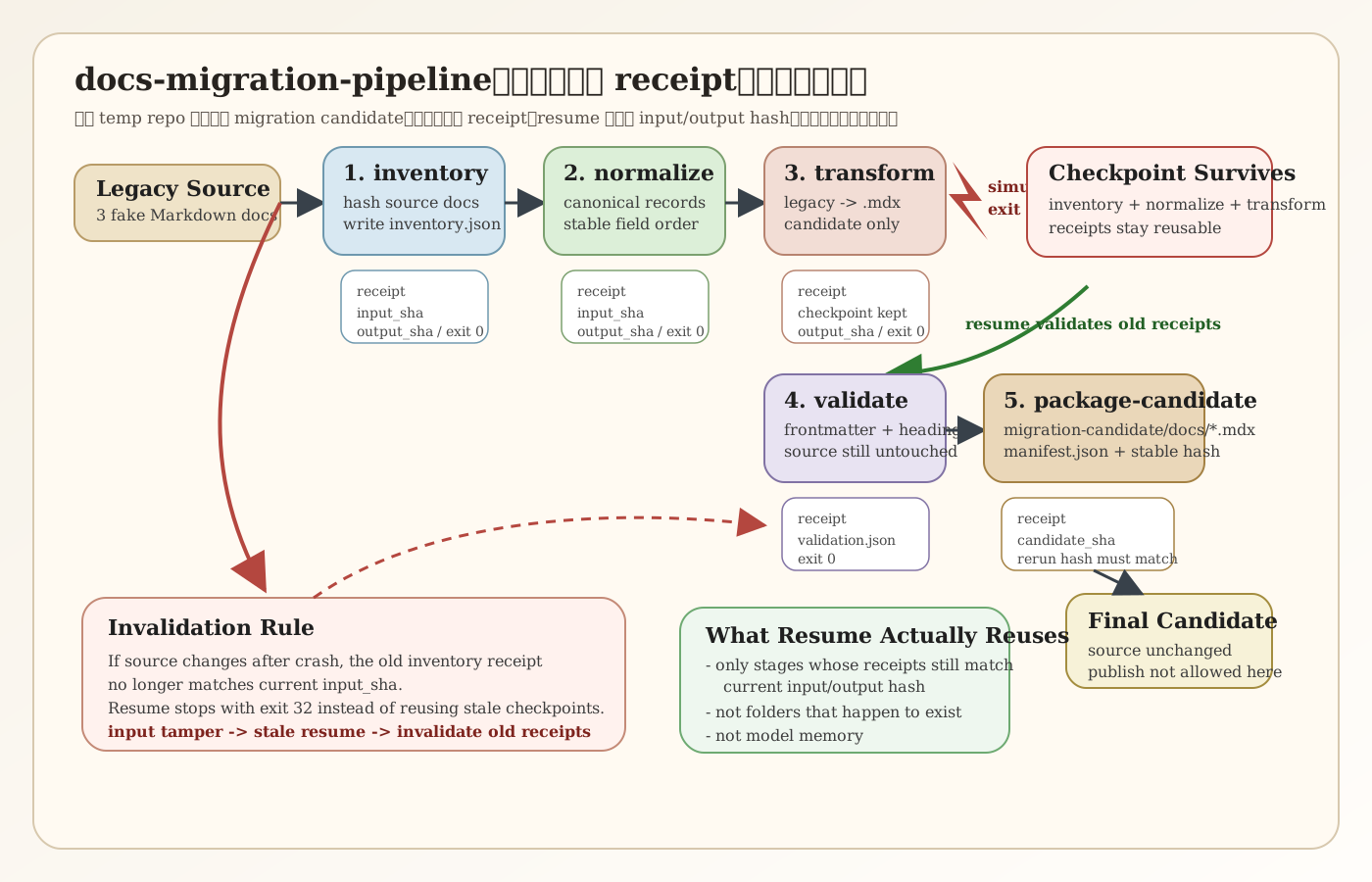 Caption: What is truly recoverable is not a “flowchart,” but each stage leaving a receipt, with resume first checking input/output hashes; a crash after transform can continue, but an old checkpoint must be invalidated as a whole after input tampering.
Why “putting the steps in a prompt” is still insufficient
Section titled “Why “putting the steps in a prompt” is still insufficient”First, consider a very common version:
Please migrate old Markdown documents into new docs:1. Inventory the files first.2. Normalize them.3. Transform them.4. Validate them.5. Package them at the end.If it fails midway, continue from the previous run.This is already far more concrete than “help me migrate,” but it still lacks four essential facts:
- What evidence supports “continue” from the previous run?
- Which stage outputs are checkpoints, and which are only temporary files?
- How do old results become invalid automatically after input changes?
- Why should rerunning produce the same candidate hash?
This is where a stage contract begins. A pipeline Skill does not merely write down an order; it makes “when a stage counts as complete, when it can be reused, and when it must be invalidated” into an inspectable contract.
OpenAI’s current Skill documentation positions Skills as reusable workflows and explicitly recommends instructions by default, moving to scripts when deterministic behavior is needed. The open Agent Skills specification designs scripts/, references/, and assets/ as resources loaded on demand. Together, these yield a direct engineering conclusion:
- The Skill body coordinates: when to use it, what to read first, and how to interpret failure codes.
- Scripts handle mechanics: hashes, file enumeration, candidate generation, and receipt validation.
- Only their combination can support resume; otherwise, the model must remember “I got to transform last time.”
A minimal recovery skeleton: what exactly does a stage contract contain?
Section titled “A minimal recovery skeleton: what exactly does a stage contract contain?”This article’s Showcase freezes an isolated temporary repository: it migrates three legacy Markdown documents into Starlight-compatible candidates. The Skill directory is:
.agents/skills/docs-migration-pipeline/├── SKILL.md├── references/stage-contract.md├── scripts/run-pipeline.mjs├── scripts/verify-receipts.mjs└── assets/receipt-template.mdThe stages are fixed as follows:
| Stage | Reads | Writes | Reusable after failure? |
|---|---|---|---|
inventory | legacy/*.md | work/inventory.json | Yes, but input hashes must be checked again |
normalize | work/inventory.json | work/normalized/*.json | Yes, subject to the same condition |
transform | normalized records | work/transformed/*.mdx | Yes; this article simulates a crash here |
validate | transformed candidates | reports/validation.json | Only a complete receipt counts as a checkpoint |
package-candidate | validated candidates | migration-candidate/docs/*.mdx + manifest.json | Final artifact; must be replayable |
These five steps are not finished merely by arranging names. Every stage writes a receipt containing at least:
input_shaoutput_shacommandexit_codestatusstarted_seqfinished_seq
There is an easy-to-miss detail here: this article deliberately does not include wall-clock time in replayable hashes. You may certainly record time in logs, but do not let wall clock time determine whether a checkpoint is reusable. Otherwise, identical input and output will be judged as different on the second run merely because the run time changed.
Receipts and checkpoints: preserve stages that are “proven complete”
Section titled “Receipts and checkpoints: preserve stages that are “proven complete””Many people understand a checkpoint as “a directory with intermediate files.” That misses another layer.
A genuinely reusable checkpoint meets at least two conditions at once:
- The stage output is bound to its receipt.
- The next run can re-verify that
receipt.input_sha == current_input_shaandreceipt.output_sha == current_output_sha.
That is why this article defines a checkpoint more strictly than “the files still exist.” Existing files do not mean the evidence remains valid.
The document-migration example makes this easier to see:
- The
transformstage writes three candidate.mdxfiles. - It also writes
receipts/transform.json. - On the next resume, the system first recalculates the normalized-input hash.
- It may skip transform only if that hash is still identical and the output hashes of all three transformed files also match the receipt.
What is reused then is not “the directory is named transformed,” but “the transform step has been proven by a receipt, and that evidence is still valid now.”
Resume is not a time-saving feature; it is a recovery protocol led by invalidation rules
Section titled “Resume is not a time-saving feature; it is a recovery protocol led by invalidation rules”This article’s Showcase freezes four key scenarios:
| Scenario | Expected exit code | What it proves |
|---|---|---|
| fresh success | 0 | The entire pipeline can generate a candidate successfully from scratch |
| crash after transform | 30 | A crash can preserve the first three stage checkpoints |
| resume after crash | 0 | Resume truly reuses the first three receipts rather than rerunning them |
| stale resume after input tamper | 32 | After input changes, old receipts must be invalidated as a whole |
| receipt missing or corrupt | 33 | Incomplete evidence cannot pretend to support recovery |
The most important part is not the numbers themselves, but that the reasons for invalidation are encoded separately:
32means input has changed and the old checkpoint is stale.33means a receipt is missing, corrupt, or does not match real output; the system cannot prove that skipping is safe.
This distinction directly affects the caller’s strategy:
- On
32, rebuild preceding stages; do not keep reusing them. - On
33, repair the evidence chain first; do not treat “the files still seem to be there” as success.
If both errors are collapsed into “resume failed,” the caller can only guess how to proceed, returning you to the world of giant prompts.
Showcase: how docs-migration-pipeline freezes crash, resume, and invalidation
Section titled “Showcase: how docs-migration-pipeline freezes crash, resume, and invalidation”This Showcase does only one small thing: migrate three legacy Markdown documents into candidates, without overwriting source or publishing. That keeps the focus on the recovery skeleton rather than real-content risk.
The offline replay entry point is:
node research/articles/pipeline-skill-design/showcase/docs-migration-pipeline/scripts/verify-showcase.mjsOffline results frozen during the writer phase on 2026-07-12:
fresh success: 0crash after transform: 30resume after crash: 0stale resume after input tamper: 32receipt issue: 33rerun stability: 0privacy scan: 0More important than one “PASS” are three concrete proofs:
1. Resume truly reused the checkpoint
Section titled “1. Resume truly reused the checkpoint”resume-summary.json freezes reused_stages as:
["inventory", "normalize", "transform"]This shows that recovery does not “roughly pick up where the crash occurred”; it explicitly skips the verified first three stages and continues only with validate -> package-candidate.
2. Tampering truly triggers invalidation
Section titled “2. Tampering truly triggers invalidation”After the crash, the Showcase deliberately appends one line to legacy/02-api-auth.md, then runs --resume. Because the input_sha for the inventory stage no longer matches the old receipt, the system reliably returns 32. This proves: resume obeys the input contract, not the wish to go faster.
3. Full reruns have stable hashes
Section titled “3. Full reruns have stable hashes”In rerun-stability.txt, the candidate_sha from two fresh-success runs is identical. This proves that the final candidate does not mix wall-clock time, absolute temporary paths, or random ordering into its output.
A real Codex recovery drill: preserve blocked first, then rerun successfully outside the host
Section titled “A real Codex recovery drill: preserve blocked first, then rerun successfully outside the host”The user requested a real, explicit Codex $docs-migration-pipeline invocation in an isolated temporary repository, completing “simulated crash -> resume -> verify receipts.” The command entry point is:
CODEX_NESTED_MODEL=gpt-5.5 \node research/articles/pipeline-skill-design/showcase/docs-migration-pipeline/scripts/run-codex-live.mjsThe writer isolation layer’s first attempt was not presented as success. It was blocked by two host constraints:
- The state DB was in a read-only location and could not write
~/.codex/state_5.sqlite. - In-process app-server initialization was blocked with
Operation not permitted.
We therefore retained the failure evidence. The outer orchestrator then corrected the output schema by adding the existing notes property to required, and reran with the same frozen fixture, prompt, schema, and gpt-5.5. The real result was:
skill_invocation: $docs-migration-pipelineexec_exit_code: 0crash_exit_code: 30resume_exit_code: 0verify_exit_code: 0source_unchanged: truecandidate_hash: cdc8bf70d44838e2239ff00052b092cb0ce7d198b77ec5b581e17f799e8dc892changed_files: migration-candidate/, receipts/, reports/, work/One deliberately less-than-pretty result remains here: the model report explicitly acknowledges that “only candidate / receipt / report changed” is false because work/ also contains checkpoints and intermediate files. This has more teaching value than hiding intermediate state, and matches the real boundary of a pipeline recovery mechanism.
The research pack also retains:
contracts/prompt.mdcontracts/final-report.schema.jsonscripts/run-codex-live.mjsresults/live-run-summary.jsonresults/codex-stderr-summary.txtresults/codex-last-message.json
An independent read-only reviewer then checked the article, frozen artifacts, and actual rendered graphic item by item, and gave PASS 98/100 with blocker / major / minor all at 0; this article was therefore elevated to showcase_status: verified.
When not to use this pipeline skeleton
Section titled “When not to use this pipeline skeleton”Not every multi-step task is worth receipts and resume.
Case one: the process is still exploratory
Section titled “Case one: the process is still exploratory”If you are changing stage boundaries every time, do not rush to add checkpoints. Defining receipts too early only fossilizes a vague process into a protocol that is harder to maintain.
Case two: the input changes wholesale all the time
Section titled “Case two: the input changes wholesale all the time”If source changes substantially each time, resume may bring little benefit while invalidations become frequent. In this case, rerunning the entire pipeline is safer than “forcing recovery.”
Case three: there is only one deterministic script
Section titled “Case three: there is only one deterministic script”If the task is fundamentally “read one input and write one output,” with neither multi-stage evidence nor intermediate checkpoints needed, a normal script is enough. Do not force it into a Skill merely for form.
Case four: the real missing piece is external-system access
Section titled “Case four: the real missing piece is external-system access”If the key problem is “access Feishu, GitHub, a database, or storage,” first clarify the MCP or connector boundary. A pipeline Skill solves orchestration and recovery; it does not replace an external connection layer.
Exercise: write an invalidation rule for your own pipeline
Section titled “Exercise: write an invalidation rule for your own pipeline”Pick a multi-stage task you have repeated recently—document migration, data organization, or a release checklist—and do not write code first. Fill in these five lines:
Stage name:This stage's input:This stage's output:Conditions that allow resume:Conditions that require invalidation:The observable completion standard is not “you feel you wrote it,” but that you can add two more statements:
- Which files or fields should this stage’s
input_shabe computed from? - If the receipt is lost, corrupt, or inconsistent with current output, which explicit exit code should the caller receive?
If you cannot answer these two questions, do not rush into recovery. Your process has not yet grown into a verifiable contract.
A directly reusable checklist
Section titled “A directly reusable checklist”Before making a multi-stage task into a pipeline Skill, go through these six questions:
Does every stage have clear input and output: yes / noCan every stage write a stable receipt: yes / noCan a checkpoint re-verify input/output hashes: yes / noIs there a clear invalidation rule when input changes: yes / noShould the final hash remain stable after a complete rerun: yes / noIf a nested run is blocked by the host, can blocked evidence be retained: yes / noOnly when most of the first five can be answered “yes” is resume worth building. Otherwise, you are merely moving complexity from the prompt into the directory structure.
The observable completion standard should also be mechanical, not “I think this time is probably fine”:
- Which stages did resume truly reuse after a crash?
- Does the old receipt reliably become invalid after tampering?
- Does the system refuse to continue when a receipt is missing?
- Are candidate hashes identical across two full reruns?
Sources and further reading
Section titled “Sources and further reading”- Agent Skills specification (primary specification; supports Skill directories,
SKILL.md,scripts//references//assets/, and progressive loading) - OpenAI Learn: Build skills (primary documentation; supports
.agents/skills, reusable workflows, and the boundary of moving to scripts when deterministic behavior is needed) - OpenAI Learn: Customization overview (primary documentation; supports the layering of
AGENTS.md, Skills, and MCP) - Claude Code Docs: Skills (primary documentation; supports extracting repeatedly pasted instructions / checklists / multi-step procedures into a Skill)
- Node.js Crypto API (primary runtime documentation; supports
createHash()as an implementation of input/output hashing) - Node.js File system API (primary runtime documentation; supports deterministic file reading, writing, and enumeration)
- Agent Skills Orange Book repository (Chinese topical map / secondary material)
Official materials support the current facts in this article about Skill containers, path layering, script boundaries, and runtime APIs; all were checked on 2026-07-12. The designs for stage contract, receipt, checkpoint, resume, invalidation, and idempotency in this article are LearnPrompt’s operational implementation and are not presented as an official specification.
The Orange Book is used only as a topical map for the idea that a pipeline Skill is a design pattern. This article read the local mirror $TMPDIR/agent-skills-orange-book/README_zh.md to confirm its author, purpose, and license boundary; its README currently says only “provided free of charge, for personal learning only,” and provides no standard open-source license. This article does not copy its PDF text, screenshots, or images, and preserves only the link, author attribution, purpose, and restriction statement.