
What Exactly Is an Agent Skill: When to Upgrade a Repeated Prompt into an On-Demand Work Package
| Difficulty | Reading time | Last verified | Author |
|---|---|---|---|
| Beginner | 14 minutes | 2026-07-12 | LearnPrompt Editorial Team |
You already have a prompt you use often. Whenever a similar task appears, you paste it in and add a few lines such as “process this directory this time,” “do not actually change files,” and “give me a plan at the end.” The first two times go fine. By the fifth, you start wondering: is this more than a prompt now? Should I make it a Skill?
Many people get stuck here. It is not that they cannot write SKILL.md; they do not know when a repeated task is worth upgrading into an on-demand work package. Go further and you hit a second trap: Skill, AGENTS.md / CLAUDE.md, ordinary scripts, MCP, and plugin often appear together, but they are not the same layer. Mix up the boundaries and you either stuff all rules into global instructions, wrap a small local procedure in a heavy and expensive plugin, or leave only a script for the next person to read and guess how to use.
This article answers only one central question: what exactly is an Agent Skill, and when should you upgrade from an ordinary prompt? It does not repeat the field guardrails, minimal template, and packaging steps already covered in How to Write Your First SKILL.md; that article covers “how to write,” while this one covers why to make one, when to make one, its boundaries, and when not to.
What you will be able to do after reading
Section titled “What you will be able to do after reading”- Explain from current official materials what a Skill is and why it is not “a longer prompt.”
- Distinguish the layers handled by prompts, Skills,
AGENTS.md/CLAUDE.md, ordinary scripts, MCP, and plugins. - Understand a real receipt-renaming case and decide why it is worth making into a Skill.
- Use a simple decision table to choose whether a repeated task should remain a prompt, become a Skill, or go straight to a script/MCP.
Do not rush to write: a Skill solves not “the prompt is not long enough,” but “the work package has not taken shape”
Section titled “Do not rush to write: a Skill solves not “the prompt is not long enough,” but “the work package has not taken shape””First clarify the easiest thing to confuse: a prompt solves what you want to do this time; a Skill solves when a similar task appears in the future, which workflow should be loaded on demand.
The open Agent Skills specification defines a Skill as a directory containing at least SKILL.md, with optional scripts/, references/, and assets/, progressively loaded in three layers: metadata, body, and resources. OpenAI’s current Codex documentation likewise describes a Skill directly as an authoring format for “reusable workflows,” and recommends preferring instructions by default, introducing scripts only when deterministic behavior or external tools are necessary. Claude Code documentation uses a more intuitive test: when you keep pasting the same instructions, checklist, or multi-step procedure into chats, or a section of CLAUDE.md has grown into a procedure rather than a fact, it should become a Skill.
These three primary sources are really saying the same thing: a Skill’s value is organizing a way of working that will happen again from a one-off prompt into a discoverable, reusable, on-demand work package with boundaries.
For a single intent, a prompt is enough. For example:
Please organize today's 3 receipts into a dry-run rename plan.This sentence can complete the task, but it does not solve three long-term problems:
- When a similar task appears next time, how does the Agent know which procedure to reuse?
- Which rules in this procedure are stable, and which are temporary context for this run?
- Should deterministic naming rules and failure codes be re-explained repeatedly in a prompt, or moved down into scripts and policy files?
Once these questions arise, you are no longer facing something solved by “adding one more prompt sentence.”
The real boundary: which part prompts, Skills, AGENTS.md / CLAUDE.md, scripts, MCP, and plugins each handle
Section titled “The real boundary: which part prompts, Skills, AGENTS.md / CLAUDE.md, scripts, MCP, and plugins each handle”The most common misuse of these six mechanisms is not having no idea how to use them; it is using the wrong layer for the wrong job. Start with a division-of-work table:
| Mechanism | What it answers | Typical vehicle | What it should not pretend to be |
| --- | --- | --- |
| prompt | What specifically must be done this time | One task description in chat | It should not handle long-term discoverability |
| Skill | Which workflow, references, and boundaries to use for this kind of task | SKILL.md + references/ + scripts/ + assets/ | It should not pretend to be a pure script |
| AGENTS.md / CLAUDE.md | Rules that always apply in this repository/project | Durable project-guidance files | They should not be filled with on-demand procedures |
| Ordinary script | Deterministic transformations and mechanical checks | scripts/*.mjs / *.py / *.sh | It should not explain when to use it |
| MCP | Connect systems, data, and tools outside the local workspace | MCP server / connector | It should not explain a local procedure |
| plugin | Distribution and installation layer | Installable package | It should not replace the workflow inside a Skill |
Start with AGENTS.md / CLAUDE.md. OpenAI’s customization documentation defines AGENTS.md as repository-level durable guidance that applies before the agent starts work, suitable for build/test commands, review expectations, and directory-level rules. Claude Code’s features overview also places CLAUDE.md in persistent context and emphasizes that it is enduring context visible in every session.
These files are best for things that are always true, such as:
- Which build command to use.
- Which directories may be changed.
- Which checks must run before commit.
- What format review output should take.
They are not suitable for an entire concrete procedure only needed while “processing receipt renames.” Otherwise every session carries a long explanation that is not always useful.
Now look at ordinary scripts. A script can perform a deterministic transformation, but it cannot naturally answer:
- When should this script run?
- Which policy file should be read first?
- What do exit
21and23mean to a human? - Is this run dry-run only?
A script can do the work, but cannot explain “why do it now, and how should failure end?” That is precisely the gap a Skill fills.
MCP is another layer. OpenAI’s customization documentation defines it as access to external tools and shared systems; Claude Code’s features overview says it “connects Claude to external services and tools.” In other words, MCP answers “what can it connect to,” not “how should it work.” If data is already in the local repository and the procedure needs no external system, forcing MCP adds boundaries and maintenance cost.
Nor should plugins be confused with Skills. OpenAI’s build-skills documentation describes a plugin as a distribution layer that others in the workspace can install; Claude’s features overview likewise calls it a packaging layer that can bundle skills, hooks, subagents, and MCP servers. It handles “how to distribute and install,” not “how a particular task executes internally.”
In one sentence: a prompt is this run’s intent; a Skill is an on-demand reusable workflow; AGENTS.md / CLAUDE.md are always-applicable rules; a script is deterministic transformation; MCP is external connectivity; and a plugin is the distribution layer.
When a repeated task is genuinely worth upgrading into a Skill
Section titled “When a repeated task is genuinely worth upgrading into a Skill”Not every frequently used prompt deserves to become a Skill. A practical test is whether it meets all four conditions below. This is LearnPrompt Editorial Team’s operating model, not official terminology, but it does not conflict with the primary documentation.
1. It recurs
Section titled “1. It recurs”For a task done only once, use a prompt. A Skill brings directory structure, maintenance, documentation, tests, and triggering metadata; pay that cost only when similar tasks will recur.
2. Its inputs, outputs, and stopping conditions are relatively stable
Section titled “2. Its inputs, outputs, and stopping conditions are relatively stable”You should at least know:
- What the input generally looks like.
- What the output generally looks like.
- Which errors should stop immediately.
- What counts as complete.
If these still change, continue exploring with prompts first. Skill-ifying too early usually just freezes a vague procedure.
3. It needs more than “this run’s context”; it needs long-term discoverability
Section titled “3. It needs more than “this run’s context”; it needs long-term discoverability”If every time you must describe again “when users mention batch receipt naming, use this policy and follow this process,” that is already a discoverable capability rather than a one-off task description.
4. One part naturally deserves deterministic implementation
Section titled “4. One part naturally deserves deterministic implementation”This is especially important. OpenAI’s current documentation explicitly recommends instructions by default and scripts only when deterministic behavior or external tooling is needed. In other words, a script is not a substitute for a Skill; it is the mechanical core most worth moving down inside a Skill.
For a task such as file naming, dates, amounts, slugs, and conflict detection should replay consistently. That is a strong signal that prompts alone are no longer enough: the work package should contain both a natural-language coordination layer and a deterministic execution layer.
Showcase: why a “batch expense-receipt rename plan” is already worth becoming a Skill
Section titled “Showcase: why a “batch expense-receipt rename plan” is already worth becoming a Skill”To keep “when it is worth upgrading” from becoming an abstract principle, this article freezes a real replayable case: receipt-renamer-skill.
Its goal is not to rename receipts directly, but a more conservative, engineering-oriented step: first generate a dry-run rename plan, then let a person decide whether to rename files.
The repository Skill in the Showcase lives in .agents/skills/receipt-renamer/ of a temporary fixture and contains:
.agents/skills/receipt-renamer/├── SKILL.md├── scripts/plan-renames.mjs├── references/naming-policy.md└── assets/report-template.mdResponsibilities are deliberately separated:
SKILL.mdcoordinates: when to use it, what to read first, which command to run, how to interpret exit codes, and when to run tests again.references/naming-policy.mddefines the filename policy:YYYY-MM-DD_merchant-slug_CURRENCYamount.pdf.scripts/plan-renames.mjsperforms deterministic conversion: read a manifest, calculate target names, check missingcurrency, check conflicts, and output JSON and Markdown dry-run reports.assets/report-template.mdsupplies the output template.
This shows the boundary between Skills and scripts exactly. A Skill cannot pretend to be a script. Leaving precise naming logic in the natural-language body means making the model guess dates, amounts, and filename details again each time; leaving only the script removes the coordination layer of when to use it, why to stop, and how to report to a person.
Three kinds of fixtures
Section titled “Three kinds of fixtures”This Showcase prepares at least three batches:
normal-batch: normal input; it should exit0.missing-currency-batch: a receipt lackscurrency; it should exit21.conflict-batch: a target filename conflicts with an existing file; it should exit23.
Run from the repository root:
node research/articles/what-are-agent-skills/showcase/receipt-renamer-skill/scripts/verify-showcase.mjsThe actual frozen results on 2026-07-12 were:
normal_exit_code: 0missing_currency_exit_code: 21conflict_exit_code: 23privacy_exit_code: 0Their deterministic meanings are also clear:
- The normal batch reliably generates
reports/normal-batch-plan.jsonandreports/normal-batch-plan.md. - When
currencyis absent, it does not continue guessing; it fails explicitly. - When a target name conflicts, it does not overwrite forcibly; it fails explicitly.
- The public research pack passes privacy scan and stores no runtime ID, absolute local-machine path, or shell absolute path.
A real explicit Codex invocation: host blocked first, then successful outer rerun
Section titled “A real explicit Codex invocation: host blocked first, then successful outer rerun”The user asked this article to make one real explicit Codex invocation in an isolated temporary Git repository, using $receipt-renamer on the normal batch. The first attempt in the writer sandbox was blocked by the read-only state DB and app-server initialization permission; this demonstrates a host boundary, not a Skill failure. The controller subsequently reran the identical fixture, prompt, and schema externally without changing the task contract.
The final frozen real-run result was:
status: completedmodel: gpt-5.5exec_exit_code: 0- The return value explicitly records
skill_invocation: "$receipt-renamer" changed_files: ["?? reports/"]reports_written: json=true, markdown=truenpm test:4/4passed- The three source PDFs retained their original names; the entire process was dry run only
This outer rerun linked “explicitly load a Skill by name, read the policy, call a deterministic script, generate two reports, then run tests” into a complete evidence chain. Production workflow remained partial at first; an independent read-only reviewer then checked the article, research pack, rendered images, and frozen results. Only after 0/0/0 findings and 96/100 was it elevated to verified.
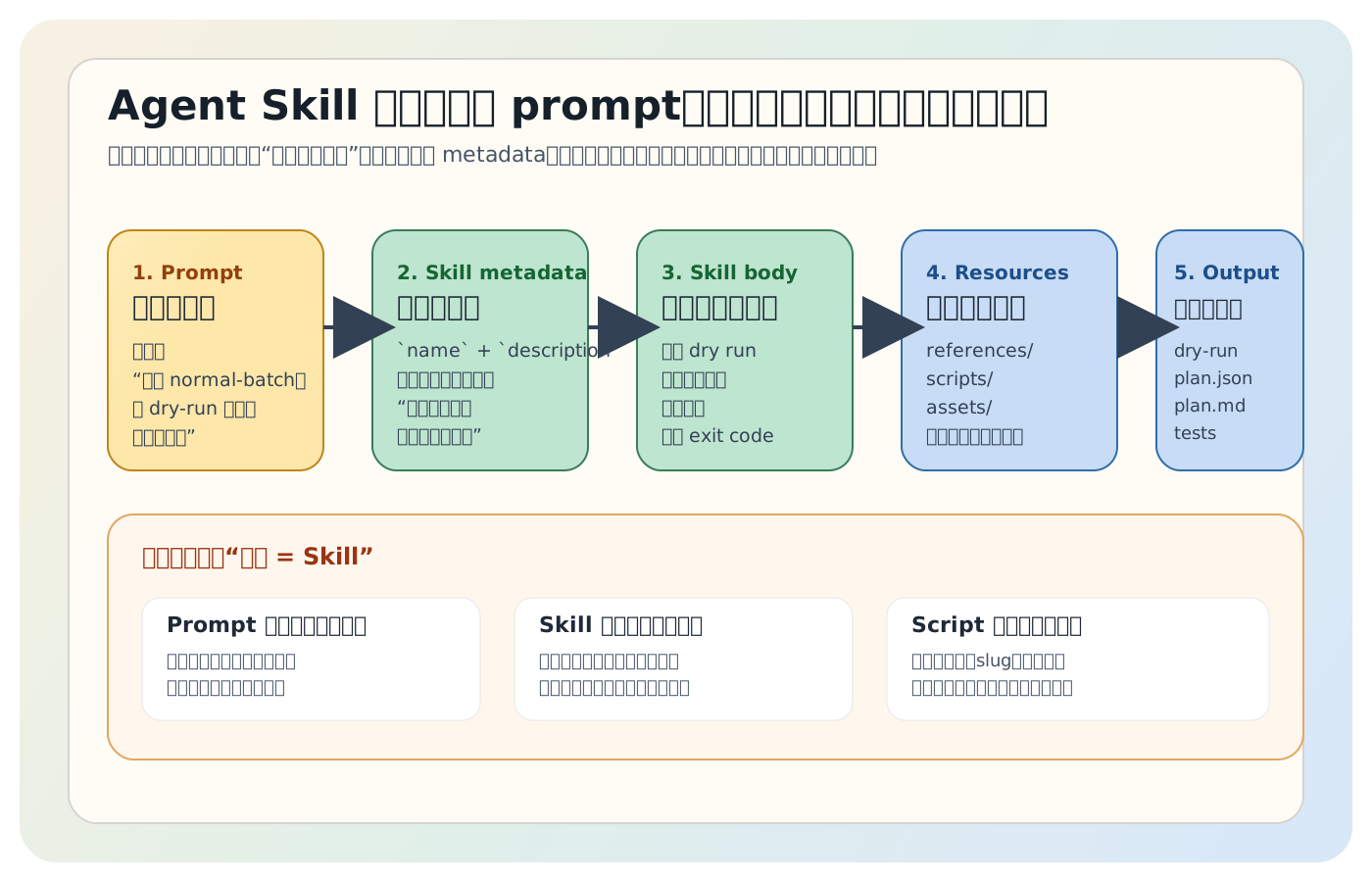 Caption: A one-off prompt first expresses “what to do this time.” Only when a task matches Skill metadata does the body load, followed by references and deterministic scripts on demand; only then is an acceptable output produced.
The judgment behind the diagram: why a Skill is not another name for “script plus documentation”
Section titled “The judgment behind the diagram: why a Skill is not another name for “script plus documentation””The diagram teaches an easily underestimated point: a Skill’s key is not only its directory structure, but the division of responsibility created by loading order.
The first layer is the prompt. It tells the Agent whether this is a normal batch or conflict batch, whether to run tests as well, and whether this run is dry-run or another task. Without it, the Agent does not know what to do now.
The second layer is metadata. Both the open specification and current client documentation put name / description first. They are the foundation of discoverability: they decide whether this work package should appear for this kind of task. Without metadata, you have a lump of documentation with no entry point for when it should be loaded.
The third layer is the Skill body. It answers “how to coordinate after entering”: confirm dry run, read the policy, run the script, then interpret failure codes. It is not a script’s prose comment; it is the workflow itself.
The fourth layer is resources. references/ holds long explanations, scripts/ holds deterministic logic, and assets/ holds templates. They load on demand, reducing context waste while moving the portions most likely to become mechanical rules downward.
Only then comes output. For this article, acceptable output is not “the model says it understands,” but:
- A dry-run JSON plan.
- A Markdown acceptance summary.
- Or an explicit exit
21/23. - Plus a stable privacy-scan result.
This is why a Skill cannot be reduced to “a script plus a README.” A README is generally for people to read, and a script normally performs only deterministic transformation; a Skill packages “when to use, how to coordinate, where to read details, how to explain failure, and when work is complete” into an on-demand work package.
When not to make a Skill
Section titled “When not to make a Skill”If this article discussed only when to make one, it would push readers to the opposite extreme: trying to Skill-ify every repeated task. In fact, many tasks are not worth it.
Situation one: it happens only once
Section titled “Situation one: it happens only once”For a task done only once, there is no reason to maintain metadata, directory structure, and triggering guidance. A prompt is the cheapest form.
Situation two: rules are still being explored
Section titled “Situation two: rules are still being explored”If you change the procedure every time after doing the task, keep exploring with prompts or simple notes. Stability, not aspiration, is the prerequisite for a Skill.
Situation three: one script is already enough
Section titled “Situation three: one script is already enough”For example, if you know you will always manually run one validation command and need neither discoverability, references, nor natural-language boundary explanations, a direct script is cleaner.
Situation four: what is missing is external connectivity, not procedure packaging
Section titled “Situation four: what is missing is external connectivity, not procedure packaging”If the essential problem is “I need the Agent to read Feishu, GitHub, or a database,” consider MCP first. A Skill can call these capabilities in a procedure, but it is not itself an external-system connector.
Situation five: you are solving team distribution rather than the procedure itself
Section titled “Situation five: you are solving team distribution rather than the procedure itself”If the workflow is already mature and your next question is “how can colleagues install it too?”, shift attention from Skill design to the plugin/distribution layer rather than continuing to add things to SKILL.md.
A simple exercise: run your recently pasted prompt through the upgrade threshold
Section titled “A simple exercise: run your recently pasted prompt through the upgrade threshold”Find a prompt you have pasted three or more times recently, and run it through this table:
Recurs: yes / noStable inputs and outputs: yes / noNeeds long-term discoverability: yes / noContains a part worth moving down into a deterministic script: yes / noIf three or more of the four are yes: Prefer considering a SkillIf what is mainly missing is durable repo-level rules: Prefer adding AGENTS.md or CLAUDE.mdIf what is mainly missing is external-system access: Prefer MCPIf it is only one fixed mechanical command: Use a script directlyThe observable completion criterion is not “you think it looks like one,” but that you can state clearly:
- What the prompt still determines for this run’s intent.
- Which rules always apply and should not go in a Skill.
- Which parts should become scripts rather than repeated model guesses.
- Whether this capability will be reused only by you or also needs plugin distribution.
If you cannot explain these four points, do not make a Skill yet. It has not grown into a real work package.
Sources and further reading
Section titled “Sources and further reading”- Agent Skills Specification (primary specification; supports directory structure, frontmatter,
scripts//references//assets/, and progressive loading) - OpenAI Learn: Build skills (primary documentation; supports Codex’s
.agents/skills,$skill, and boundaries between scripts and deterministic behavior) - OpenAI Learn: Customization overview (primary documentation; supports layers for
AGENTS.md, Skills, and MCP) - Claude Code Docs: Extend Claude with skills (primary documentation; supports
/skill-name,.claude/skills, and boundaries betweenCLAUDE.mdand procedures) - Claude Code Docs: Features overview (primary documentation; supports divisions among
CLAUDE.md, Skills, MCP, and plugins) - Claude Platform Docs: Agent Skills overview (primary documentation; supports sharing and path boundaries across Claude surfaces)
- Agent Skills Orange Book repository (Chinese thematic map / secondary material)
Official material supports the current behavior in this article concerning Skill structure, paths, loading, layers, and surface boundaries, all rechecked on 2026-07-12. The offline replay, privacy scan, and outer real explicit Codex invocation of receipt-renamer-skill were also actually rerun that day.
The Orange Book is used only as a thematic map for this conceptual article. This article read the conceptual passages of the local temporary mirror agent-skills-orange-book-zh.txt and agent-skills-orange-book/README_zh.md to organize the Chinese mental model; the author is Huashu. The repository README currently states that it is for personal learning reference only, provides no standard open-source license, and does not authorize unlicensed commercial distribution. This article copies no PDF body text, screenshots, or images; it retains only the link, author attribution, purpose, and limitation statement.